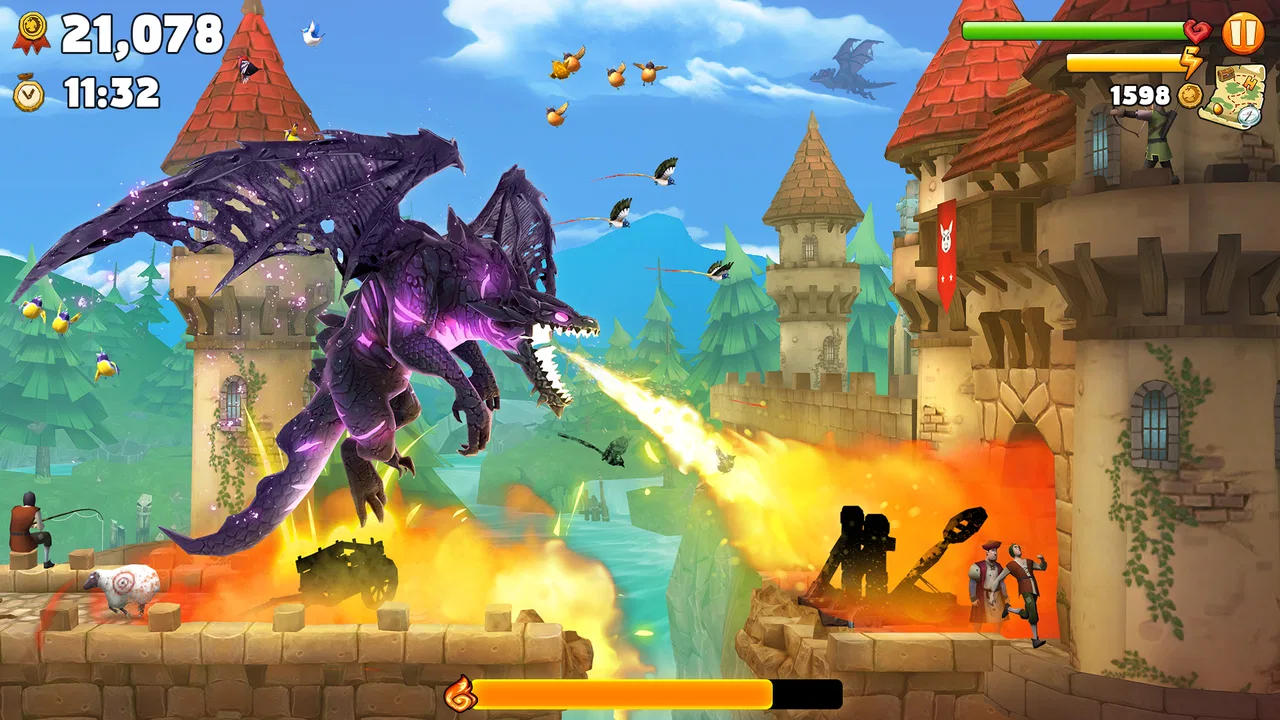
Hungry Dragon: by Hungry Shark
- 4.5
- Rating
- 10.00M
- Installs
- Free
- Price

 Analysis by App-foxy
I spent time with Hungry Dragon as an arcade game and came away with a clear impression: it is built for quick, energetic sessions rather than quiet, methodical play. You guide a dragon through a dangerous world, eat what you can, dodge threats, and try to keep the run alive long enough to improve your score and unlock more potential. The basic idea is easy to understand within minutes, but the pressure rises quickly once the screen fills with hazards and targets.
That combination makes it a good fit for someone who wants an action game that can be started without a long tutorial or complicated setup. It is free to download, although optional purchases range from $0.99 to $79.99 per item. I would approach it as a game designed around short bursts of play, with enough progression to encourage longer sessions when I feel like chasing a better run.
How fast the game feels in ordinary play
The first thing I noticed is that the game communicates speed through constant movement. The dragon is rarely sitting still, and the safest choice is often to keep moving, look for something edible, and avoid wasting time in dangerous areas. This gives each attempt a lively rhythm. Even when I was not actively chasing a record, the run felt busy because there was always another target, obstacle, or route decision in front of me.
You May Also Like

 Blood Strike: 2.5 Anniversary
Blood Strike’s Loadouts Turn Every Drop Into a Tactical Gamble
A close look at Blood Strike’s custom loadouts: how fast access to signature weapons reshapes its battle royale rhythm, rewards preparation, and narrows the gap between fights.

 Pandora - Music & Podcasts
Pandora’s Music Is Easy to Start, but Harder to Recover
Pandora’s strength is its low-effort path from a seed to a station. Its weak spot is how much confidence it asks you to place in connection, setup, and quiet recovery.

 8 Ball Pool
 Is Built on Rivalries, Rematches, and Routine
A close look at the rivalries, rematches, shared routines, and unanswered safety questions that turn a quick pool match into a persistent mobile community.

 Samsung Music
’s Quiet Strength Is Playing What You Already Own
Its reach comes less from spectacle than from dependable access to a personal library. That simplicity is both the app’s strongest retention engine and its ceiling.

 AccuWeather: Weather Radar
AccuWeather Review: A Quick, Clear Forecast for Everyday Decisions
For everyday plans, the best forecast is the one you can understand quickly. AccuWeather makes rain timing, radar, and local conditions easy to act on, with a few trade-offs.

 Hill Climb Racing
Why Hill Climb Racing Still Turns Crashes Into One More Run
A tiny car, a bumpy hill and one more upgrade: Hill Climb Racing keeps resurfacing because its simple chaos makes every near-miss feel personal.
More From Our News Desk



The controls are approachable, which matters in an arcade game where hesitation can end a run. I did not need to learn a large set of commands before enjoying the main loop. The challenge comes less from memorizing buttons and more from judging when to push forward, when to change direction, and when a tempting target is not worth the risk.
That speed can be exciting, but it also creates a small learning curve. New players may initially focus so much on eating that they overlook the danger around the target. I found better results came from treating every screen as a route-planning problem rather than simply rushing toward the nearest reward. The fastest-looking path is not always the quickest way to a strong run.
For everyday use, this makes the game particularly suitable for a commute, a short break, or a few minutes before bed. A single attempt can feel meaningful even when it ends quickly. On the other hand, anyone looking for a slow arcade experience with generous reaction time may find the pace tiring, especially after several unsuccessful runs.
Why the first minutes are easy to understand
The central loop is immediately readable: move, consume, survive, and improve. I appreciated that the game does not require me to understand a complicated story before the action becomes enjoyable. The dragon fantasy gives the mechanics personality, while the arcade structure keeps the focus on what is happening right now.
There is also a useful difference between learning the controls and mastering the game. Learning is quick, but mastery depends on recognizing patterns in the environment and knowing when to stop taking unnecessary chances. That distinction gives the game more staying power than a simple score-chasing title that feels solved after the first session.
My practical advice is to spend the opening attempts learning the safest routes instead of chasing every available target. It is tempting to treat the early part of a run as disposable, but a calm start helps build a better rhythm for the more demanding sections. Once movement feels natural, I could concentrate on decisions rather than fighting the controls.
What happens during heavier play sessions
The busiest moments arrive when several things compete for my attention at once. I may be trying to reach food, watching for a threat, and deciding whether to continue deeper into the level or turn back toward a safer route. These moments are where the arcade design works best because the game asks for quick choices without requiring a long explanation.
Longer sessions can become more demanding than short ones, not only because the action is intense but because concentration starts to matter. A mistake after a careful run feels more frustrating than an early failure, particularly when I had become overconfident and took a risky shortcut. I found that alternating between aggressive and conservative attempts helped prevent the game from becoming mentally exhausting.
One useful approach is to give each run a specific purpose. I might focus on learning a route, testing how far I can safely travel, or simply collecting what is immediately available. This prevents every attempt from feeling like a failed high-score challenge. It also makes progression easier to appreciate because improvement is not limited to one final number.
When the screen becomes crowded, visual attention is more important than raw reaction speed. I had better results when I looked slightly ahead of the dragon instead of staring only at its current position. That habit gives more time to identify a safe direction. It is a small adjustment, but it changes the game from frantic improvisation into something more controlled.
Managing the trade-off between greed and survival
The most interesting decision in Hungry Dragon is often whether a reward is worth the route required to reach it. A target may look close but force me toward a hazard, while a less exciting option may keep the run stable. This gives the game a strategic layer that is easy to miss if I play only by instinct.
I also learned not to treat every successful move as a reason to continue pushing. Sometimes the best choice is to preserve a good run instead of turning it into a desperate attempt for a little more progress. That advice is especially relevant for players who become frustrated by repeated late failures. The game rewards confidence, but it also punishes careless momentum.
The optional purchase system is another consideration during heavier use. The game is free to play, but the listed in-app purchase range reaches from $0.99 to $79.99 per item. I would recommend deciding in advance whether I want to play entirely without spending or set a strict limit. The arcade loop is easier to enjoy when purchases remain a choice rather than becoming part of the pressure to recover from a disappointing run.
Reliability and the experience of recovering from a bad run
As a game from Ubisoft Entertainment, Hungry Dragon has a recognizable level of polish in its presentation and basic arcade structure. My overall experience was easy to pick up and return to. The current version is 5.7, and the game has been available since August 29, 2018, so it is not a brand-new experiment trying to prove its core idea.
The most important kind of reliability here is not just whether the game opens, but whether I can understand what went wrong when a run ends. In that respect, the design is fairly direct. Failure usually feels connected to a risky movement choice, missed warning, or decision to keep going when the safer option was available. That clarity makes it easier to try again instead of feeling that the outcome was completely random.
Recovery is also helped by the short-session structure. After a poor attempt, I can restart mentally without needing to remember a complicated sequence of objectives. I can change one habit at a time: take fewer unnecessary risks, watch farther ahead, or avoid becoming distracted by a tempting target. This makes repeated attempts feel like practice rather than pure repetition.
Still, the game can be demanding when I am not fully focused. Because the action is continuous, looking away for even a moment can make it difficult to recover my position. I would not choose it when I need to divide attention between the game and another task. It works better when I can give it a few uninterrupted minutes, even if the individual run itself is brief.
When restarting feels fair, and when it feels frustrating
A good arcade game needs failure to be quick enough that another attempt feels reasonable. Hungry Dragon generally benefits from that structure. I do not have to spend a long time rebuilding a complicated setup before trying a different approach. That makes it forgiving in terms of time, even when the action itself is not forgiving in terms of mistakes.
The frustration appears when I repeat the same risk without changing my method. The game can encourage a “one more try” mindset, but that only helps if each attempt teaches me something. I found it more satisfying to pause briefly after a failure and identify the decision that ended the run. That simple recovery habit made progress feel more intentional.
For parents or younger players, the Teen content rating is worth noting. The game’s fantasy violence and creature-focused action may be fine for some families, but the rating means it should not automatically be treated as a children’s title. I would check whether its tone suits the intended player rather than relying only on the colorful presentation.
Device limits, operating-system support, and resource expectations
The minimum operating-system requirement is Android 6.0, which makes the game available to a broad range of Android devices. That does not mean every older phone will deliver the same comfort during busy action. A device’s age, available storage, background activity, and general condition can all affect how pleasant an arcade game feels, even when the operating system meets the requirement.
I would install it on a phone with enough free space and close demanding applications before a longer session. This is not because I can promise a particular result on every model, but because continuous action is less enjoyable when the phone is already struggling with other work. If the device feels warm or the battery is low, shorter sessions are the sensible choice.
Players using older hardware should pay attention to how the game feels during the most crowded sections, not only during the opening moments. A title can seem perfectly comfortable at the beginning and become less pleasant once more movement and visual activity appear on screen. If responsiveness starts to interfere with steering, reducing other background activity or moving to a newer device is more useful than simply playing more aggressively.
Storage and data habits also matter in practical use. Since the game is a substantial arcade experience rather than a tiny one-screen diversion, I would avoid installing it when the phone is nearly full. Keeping some free room helps maintain a healthier device overall, even though the exact space used can differ by phone and installation state.
Who should choose another arcade game
I would skip Hungry Dragon if my priority is a completely offline, interruption-free experience with no purchase prompts or progression pressure. The free entry point is appealing, but the presence of in-app purchases means players who prefer a strictly paid-once or fully minimal model may feel more comfortable elsewhere.
I would also look at other arcade options if I wanted simple score attacks with almost no visual distraction. This game’s dragon theme and survival pressure create a more active experience than a minimalist reflex title. Likewise, players who dislike repeating runs after failure may prefer a slower game with checkpoints or a more forgiving campaign structure.
For someone who enjoys action, creature-themed fantasy, and quick attempts that gradually improve through better decisions, it is a stronger match. The game does not demand that I understand a large set of systems before having fun, but it gives experienced players room to refine movement and risk management. That balance is the main reason I kept returning to it.
My performance verdict after repeated sessions
Hungry Dragon feels fastest and most enjoyable when I treat it as a focused arcade game rather than a background activity. Its action is immediate, its controls are approachable, and its survival loop creates a clear reason to attempt another run. The experience is especially effective in short sessions, where the pressure feels exciting instead of exhausting.
Its large audience reflects that accessibility: the game holds a 4.5 average from around 371 thousand ratings and has passed 10 million installs. Those figures do not replace personal testing, but they fit my impression that the core idea is easy for many players to understand. The important question is whether the player enjoys repeated movement, risk-taking, and gradual improvement.
My main caution is that performance expectations should be realistic on older devices. The Android 6.0 minimum makes the compatibility floor relatively broad, but meeting a software requirement is not the same as guaranteeing a smooth experience in every demanding moment. I would test it on the intended phone before committing to long sessions, especially if that device already struggles with other games.
I also recommend setting a spending boundary before playing. Because the game is free but offers items from $0.99 to $79.99, it is best approached with a clear personal rule. I enjoyed the action more when I focused on learning routes and making safer decisions instead of treating purchases as a way to solve every frustrating attempt.
Overall, I would recommend it to a friend who wants a lively arcade game that can fill a few spare minutes while still rewarding better judgment over time. I would not recommend it to someone seeking a calm, low-pressure experience or a game designed around guaranteed progress. For the right player, the real strength is its mix of immediate speed and recoverable failure: a run can end quickly, but the next attempt is always understandable, purposeful, and easy to begin.
FAQs for Hungry Dragon: by Hungry Shark
01What is Hungry Dragon, and how is the gameplay structured?
Hungry Dragon is an arcade action game from Ubisoft in which you control a flying dragon through a fantasy world filled with prey, enemies, treasures, and hidden areas. The main objective is to keep eating to maintain your fire, explore the map, complete missions, and unlock stronger dragons. Sessions are easy to start, but discovering every secret and improving your score gives the game considerable long-term appeal.
02Is Hungry Dragon free to download and play?
Yes, Hungry Dragon can be downloaded and played for free on compatible Android and iOS devices. However, the game includes optional in-app purchases and may use advertising or other monetized features. You can make progress without paying, especially if you are patient, but purchases may speed up upgrades, unlock content, or provide additional resources. Parents should review purchase settings before allowing children to play.
03Does Hungry Dragon require an internet connection?
Some parts of Hungry Dragon may work without a constant internet connection, allowing you to enjoy basic gameplay when offline. Nevertheless, an internet connection can be required for advertisements, purchases, cloud-related features, events, updates, and certain account functions. Availability may also vary depending on your device and game version, so it is best to launch the game online at least occasionally.
04Is Hungry Dragon suitable for children?
Hungry Dragon is colorful, humorous, and relatively easy to understand, making it accessible to many younger players. The action includes fantasy combat, fire, and dragons eating creatures, but it is presented in a cartoon-style manner rather than realistic violence. Since the game may contain advertisements and optional purchases, parents should check the store age rating, supervise younger users, and enable suitable parental controls.
05What devices and storage space are needed to play Hungry Dragon comfortably?
Hungry Dragon requires a compatible Android or iOS device with enough free storage for the initial installation and future updates. The exact requirements can change as the game is updated, so checking the current Google Play Store or App Store listing is recommended before downloading. On older phones and tablets, performance may be less consistent, particularly during busy scenes with many effects and characters on screen.
Pros
- Fast-paced flying controls make short sessions fun and easy to start.
- Many dragons offer distinct abilities
- sizes
- and upgrade paths.
- Large fantasy levels contain hidden areas
- collectibles
- and surprise events.
- Pets and costumes add variety and help customize each dragon.
- Offline play is available for enjoying the core game without a connection.
Cons
- Energy limits can interrupt play and encourage waiting or spending gems.
- Higher-tier dragons require considerable grinding to unlock.
- Frequent visual effects can make busy areas feel cluttered on small screens.
- The game uses substantial storage because of its detailed graphics and content.
- Some missions and rewards may feel repetitive after extended play.

Hungry Dragon: by Hungry Shark
Gallery